


The BBC used EMT plates a lot (especially since they took up less space than an echo room, and echo rooms were valuable real estate that could be re-used for other purposes such as storing the Director-General's vintage wine collection).
The plates were suspended at the corners by springs which were connected to the 'chassis' by threaded rods. To set the plate up correctly, the springs all had to be a specific tension. Dick Hammett, a colleague of mine at the time and a musician, thought up a clever way of setting the springs. Rather than measuring the tension using specialised equipment, he tuned them using a tuning fork as reference. Neat!
Ray
(ps the DG's wine collection was a joke)
That Early Shadows Sound
Re: That Early Shadows Sound
 by RayL » 02 Sep 2010, 14:24
-
RayL - Posts: 1247
- Joined: 16 Sep 2009, 16:25
- Location: Carshalton, Surrey
Re: That Early Shadows Sound
by roger bayliss » 02 Sep 2010, 14:38
dave robinson wrote:At the risk of taking some flak here, I personally think that the Shadows - or Drifters as they were then, had an aweful sound on their own records until we hear 'Saturday Dance'. Before that single I can only describe the sound as flat and lifeless, It's as through they were given new, better instruments to play from then on and that the recording people actually gave a thought to getting a good sound. It isn't just an opinion because it's there for all to hear chronologically on boxed set of the 'A's and B's' singles collection. From 'Saturday Dance' onwards everything sounds massively better, but the earlier Cliff records , particularly 'Move It' on which The Shadows don't appear, have the same magic. Any other thoughts on this ?
Dave could it be that 'Move it' was the first record Malcolm Addey did his work on I believe it was his first attempt. It's interesting to note that Malcolm mentions riding the gain with Norrie Paramour looking on and smiling at him... some of those recording do go into the realms of a nice but subtle degree of break up so recording levels were high. On At Abbey Rd on the Witch Doctor session you can hear Bruce Welch requesting the engineers via Norrie to bring Jet up at the start and he says they were pretty much at the top end of the peak level as it were. Also Malcolm said that the amps on the disc cutters were not really anywhere near as powerful as they should be so maybe they compensated for this at the recording end ?
As for the reverb it's gonna be the room reverb I would say just listen again on headphones and hear the tails .... theres plenty of it and it's significant to affect the way the guitar sounds and decays , like the opening on Man of Mystery there is almost a distortion there but it maybe the way the reverb works its magic . Kon Tiki. The Stranger and Apache have it too quite noticible such as the finishing run up on the 6th string towrds the close of Apache you can see that it transforms the sound of that somewhat to make it what it is.. I would say room reverb with plenty of delay is where the model might be but it is difficult to emulate it successfully.
I think Lexicon units are very well revered and probably are amongst some of the better ones out there but no one yet has successfully modelled the Abbey Road Reverb. It was probably the reverb that contributed to the 'Wall of Sound' recordings by Phil Spector as they built a special reverb chamber at the studios where that special sound came from too a(along with Spectors recording techniques of course)
So maybe the reverb is vitally important in getting an above average recording afterall why go to all the trouble of building special rooms ...

American Pro Series Strat 2017, G&L S500 Natural Ash
-

roger bayliss - Posts: 1784
- Joined: 15 Sep 2009, 00:15
Re: That Early Shadows Sound
by Didier » 02 Sep 2010, 17:49
almano wrote:The plate reverbs were generally the EMT Plate Reverb units which were enormous integrated ‘stand alone’ items. Many studios used them in the late fifties, sixties and seventies until the digital versions took over.
The major studios all had these reverb units (some still do!) and, I believe EMI used them as well (probably in tandem with a dedicated room for different tonal effects) – but I’ll check that out when I can find the old copy of Studio Sound which had a ten or twelve page article about the Abbey Road studios in the early sixties – it’s at the bottom of one of those tea chests somewhere!
The EMT plate reverb units appeared in 1957, and were a substitude for sudios which didn't have a reverb chamber (very few had), but I doubt Abbey Road used these units, as they had better : their famous reverb chamber !
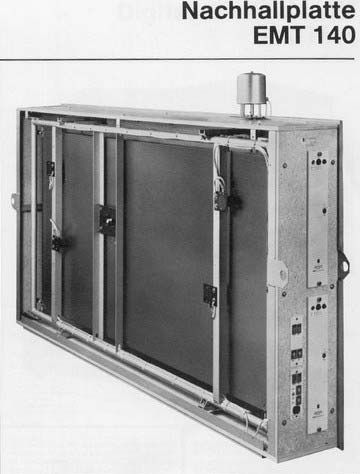
The plate was 4'x8' which made the unit bulky and very heavy.
Didier
-

Didier - Posts: 1934
- Joined: 15 Sep 2009, 10:57
- Location: West suburb of Paris, France
Re: That Early Shadows Sound
by JimN » 02 Sep 2010, 18:07
roger bayliss wrote:As for the reverb it's gonna be the room reverb I would say just listen again on headphones and hear the tails .... theres plenty of it and it's significant to affect the way the guitar sounds and decays, like the opening on Man of Mystery; there is almost a distortion there but it may be the way the reverb works its magic . Kon Tiki. The Stranger and Apache have it too quite noticible such as the finishing run up on the 6th string towrds the close of Apache you can see that it transforms the sound of that somewhat to make it what it is.. I would say room reverb with plenty of delay is where the model might be but it is difficult to emulate it successfully.
I think Lexicon units are very well revered and probably are amongst some of the better ones out there but no one yet has successfully modelled the Abbey Road Reverb...
So maybe the reverb is vitally important in getting an above average recording afterall why go to all the trouble of building special rooms ...
Whilst it's tempting for us here to think only in terms of The Shadows' (and related and similar) records, that special EMI sound is on display on many other recordings emanating from Abbey Road, whether produced by Norrie Paramor, Norman Newell, Wally Ridley, George Martin (well, once George discovered stereo, anyway) or any EMI A&R man. Listen to any stereo Matt Monro track for instance (he's always been a favourite of mine). The recording quality is pure magic.
Contemporary 1960s tracks at Philips, Decca and Pye could theoretically have sounded as good - but they often (perhaps usually) didn't. And none of the independents could get anywhere near the EMI sound.
JN
-
JimN - Posts: 4559
- Joined: 17 Sep 2009, 23:39
Re: That Early Shadows Sound
by dave robinson » 02 Sep 2010, 18:27
JimN wrote:roger bayliss wrote:As for the reverb it's gonna be the room reverb I would say just listen again on headphones and hear the tails .... theres plenty of it and it's significant to affect the way the guitar sounds and decays, like the opening on Man of Mystery; there is almost a distortion there but it may be the way the reverb works its magic . Kon Tiki. The Stranger and Apache have it too quite noticible such as the finishing run up on the 6th string towrds the close of Apache you can see that it transforms the sound of that somewhat to make it what it is.. I would say room reverb with plenty of delay is where the model might be but it is difficult to emulate it successfully.
I think Lexicon units are very well revered and probably are amongst some of the better ones out there but no one yet has successfully modelled the Abbey Road Reverb...
So maybe the reverb is vitally important in getting an above average recording afterall why go to all the trouble of building special rooms ...
Whilst it's tempting for us here to think only in terms of The Shadows' (and related and similar) records, that special EMI sound is on display on many other recordings emanating from Abbey Road, whether produced by Norrie Paramor, Norman Newell, Wally Ridley, George Martin (well, once George discovered stereo, anyway) or any EMI A&R man. Listen to any stereo Matt Monro track for instance (he's always been a favourite of mine). The recording quality is pure magic.
Contemporary 1960s tracks at Philips, Decca and Pye could theoretically have sounded as good - but they often (perhaps usually) didn't. And none of the independents could get anywhere near the EMI sound.
JN
I couldn't agree more Jim.
Dave Robinson
-

dave robinson - Posts: 5274
- Joined: 09 Sep 2009, 14:34
- Location: Sheffield
Re: That Early Shadows Sound
by John M » 02 Sep 2010, 19:24
I think Charlie Hall has an Abbey Road reverb patch in his later versions for the Q2 & Q20.
- John M
Re: That Early Shadows Sound
by Didier » 03 Sep 2010, 08:45
JimN wrote:Contemporary 1960s tracks at Philips, Decca and Pye could theoretically have sounded as good - but they often (perhaps usually) didn't. And none of the independents could get anywhere near the EMI sound.
JN
Jim,
At this time, most record companies didn't care much about sound quality for pop music, and some didn't even bother to use stereo. They did only for classical music.
Decca had excellent sound quality for classical music.
Didier
-
Didier - Posts: 1934
- Joined: 15 Sep 2009, 10:57
- Location: West suburb of Paris, France
Re: That Early Shadows Sound
by almano » 03 Sep 2010, 12:11
Re: Malcolm Addey’s recollections on the EMI echo/reverb room which described the equipment used at the time. Malcolm said: “A Neumann KM53 omnidirectional mic was placed at one end of the room, while at the other end, pointing slightly upwards and towards a corner, there was a Tannoy 15-inch dual-concentric speaker driven by a Leak TL25 amp.â€
Now, an interesting thought that’ll most probably attract more than a few brick bats is the use of a 15†Tannoy speaker driven by a Leak TL25 as the sound source in the EMI echo/reverb room.
Although the Tannoy and Leak combination are good in themselves – surely some better amp and speaker combinations of the day would have produced a smoother sound for the Neumann mic to pick up? Perhaps something like two Quad Electrostatics used as a stacked pair driven by the appropriate Quad II amps would have given a cleaner sound source for the echo/reverb.
It’s just a thought (and purely an observation) as I say, but the Tannoy and Leak combo probably would have contributed a slightly coloured “extra†sound to the echo/reverb feed. But - it is exactly such things like these small points (and various others of course) that all add up in the end, and then finish up contributing their sonic qualities to a hopefully rather interesting final sound signature of a classic recording.
Cheers,
Alan
Now, an interesting thought that’ll most probably attract more than a few brick bats is the use of a 15†Tannoy speaker driven by a Leak TL25 as the sound source in the EMI echo/reverb room.
Although the Tannoy and Leak combination are good in themselves – surely some better amp and speaker combinations of the day would have produced a smoother sound for the Neumann mic to pick up? Perhaps something like two Quad Electrostatics used as a stacked pair driven by the appropriate Quad II amps would have given a cleaner sound source for the echo/reverb.
It’s just a thought (and purely an observation) as I say, but the Tannoy and Leak combo probably would have contributed a slightly coloured “extra†sound to the echo/reverb feed. But - it is exactly such things like these small points (and various others of course) that all add up in the end, and then finish up contributing their sonic qualities to a hopefully rather interesting final sound signature of a classic recording.
Cheers,
Alan
- almano
Re: That Early Shadows Sound
by roger bayliss » 03 Sep 2010, 16:03
dave robinson wrote:At the risk of taking some flak here, I personally think that the Shadows - or Drifters as they were then, had an aweful sound on their own records until we hear 'Saturday Dance'. Before that single I can only describe the sound as flat and lifeless, It's as through they were given new, better instruments to play from then on and that the recording people actually gave a thought to getting a good sound. It isn't just an opinion because it's there for all to hear chronologically on boxed set of the 'A's and B's' singles collection. From 'Saturday Dance' onwards everything sounds massively better, but the earlier Cliff records , particularly 'Move It' on which The Shadows don't appear, have the same magic. Any other thoughts on this ?
The other thing I forgot to mention was that Malcolm Addey said he started miking the amps closer than other enginners before him had done so that was a definete change about that time
Quote off Malcolm Addey
"At that time I would have positioned the mic about six to 12 inches away from the F hole, which is a greater distance than we would use today," Addey explains. "We'd do that to be cautious. The overhead on the drums would be about six feet off the floor above the kit, which in those days consisted of a snare drum and bass drum, and we didn't use a bass drum mic. For the guitars, I placed the microphones extremely close to the speakers, and that was perhaps a little innovative because the other engineers weren't doing that back then."
American Pro Series Strat 2017, G&L S500 Natural Ash
-
roger bayliss - Posts: 1784
- Joined: 15 Sep 2009, 00:15

Who is online
Users browsing this forum: Google [Bot] and 17 guests
These advertisements are selected and placed by Google to assist with the cost of site maintenance.
ShadowMusic is not responsible for the content of external advertisements.